.jpg?width=1200&height=800&ext=.jpg)

That’s where problems show up.
Teams lose visibility. Admin work piles up. Costs start slipping through the cracks.
And with global business travel spend expected to pass $1.6 trillion in 2026, even small inefficiencies add up fast.
That’s why more companies are rethinking corporate travel and expense management. Not as separate tasks, but as one connected workflow.
This guide walks through what actually works, and where it starts to break down for field teams.
What a Corporate Travel and Expense Management System Does

2. Set Clear Policies (But Keep Them Flexible)
Travel policies are important. They give teams clear guidelines on how to book and spend.
But rigid policies don’t hold up in real life.
Trips change. Schedules shift. Exceptions happen.
Good policies should cover:
- How people book
- What needs approval
- Spending limits
- How exceptions are handled
The key is balance.
You need enough structure to control costs, but enough flexibility to deal with change without slowing everything down.

4. Track the Right Metrics (Not Just Spend)
Most teams focus on total spend.
But spend alone doesn’t tell you what’s actually happening.
Stronger travel expense management looks at things like:
- Cost per trip
- How often plans change
- Cancellations and unused bookings
- Rebooking patterns
These give you a better picture of where the problems are.
Because often, the highest cost isn’t the booking, it’s everything around it.
They deal with:
- Rotating crews
- Remote job sites
- Multiple locations at once
- Constant changes
At that point, you’re not just managing trips.
You’re coordinating people, locations, and timing all at the same time.
That’s where traditional systems start to struggle.
They weren’t designed for that level of complexity.

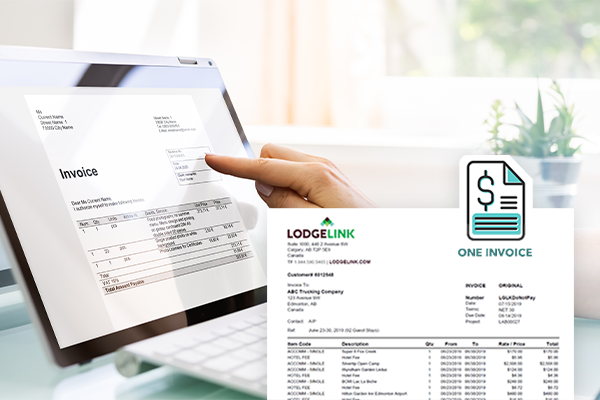
For field teams managing lodging across multiple projects and vendors, invoicing is usually where the highest hidden cost sits. Every stay generates its own invoice, and every invoice goes through the same expensive process: collect, review, code, approve, reconcile.
One LodgeLink customer with more than 500 travelling employees was processing over 11,000 individual lodging invoices per year before adopting consolidated invoicing. At the industry benchmark of 20 minutes and $58 per invoice, that scale of work translated to roughly 3,700 hours of admin time and $638,000 in processing costs annually.
After consolidating lodging into a single monthly invoice through LodgeLink, that same customer dropped to 600 invoices per year, a 95% reduction. Admin time fell to about 200 hours and processing costs fell to roughly $34,800.
The Shift from Managing Travel to Coordinating It


Consolidated invoicing solves the volume problem. Coding solves the allocation problem. Field operations run on projects, cost centres, and budgets that need to be tracked separately, not one big lodging line item.
Every booking on LodgeLink can be tagged with the codes finance teams already use: Payment IDs, Tracking Codes, cost centre codes, GL codes, project codes, AFE numbers. Those codes flow into the consolidated invoice, so lodging costs land in the right project or department without manual re-coding at month-end.
That structure keeps three parts of the workflow aligned: